Targeting mTOR in myeloid cells prevents infection-associated inflammation
2025.06.12.
Yohana C Toner, Jazz Munitz,.., Willem JM Mulder et al., iScience, 2025
Summary
Infections, cancer, and trauma can cause life-threatening hyperinflammation. In the present study, using single-cell RNA sequencing of circulating immune cells, we found that the mammalian target of rapamycin (mTOR) pathway plays a critical role in myeloid cell regulation in COVID-19 patients. Previously, we developed an mTOR-inhibiting nanobiologic (mTORi-nanobiologic) that efficiently targets myeloid cells and their progenitors in the bone marrow. In vitro, we demonstrated that mTORi-nanobiologics potently inhibit infection-associated inflammation in human primary immune cells. Next, we investigated the in vivo effect of mTORi-nanobiologics in mouse models of hyperinflammation and acute respiratory distress syndrome. Using 18F-FDG uptake and flow cytometry readouts, we found mTORi-nanobiologic therapy to efficiently reduce hematopoietic organ metabolic activity and inflammation to levels comparable to those of healthy control animals. Together, we show that regulating myelopoiesis with mTORi-nanobiologics is a compelling therapeutic strategy to prevent deleterious organ inflammation in infection-related complications.
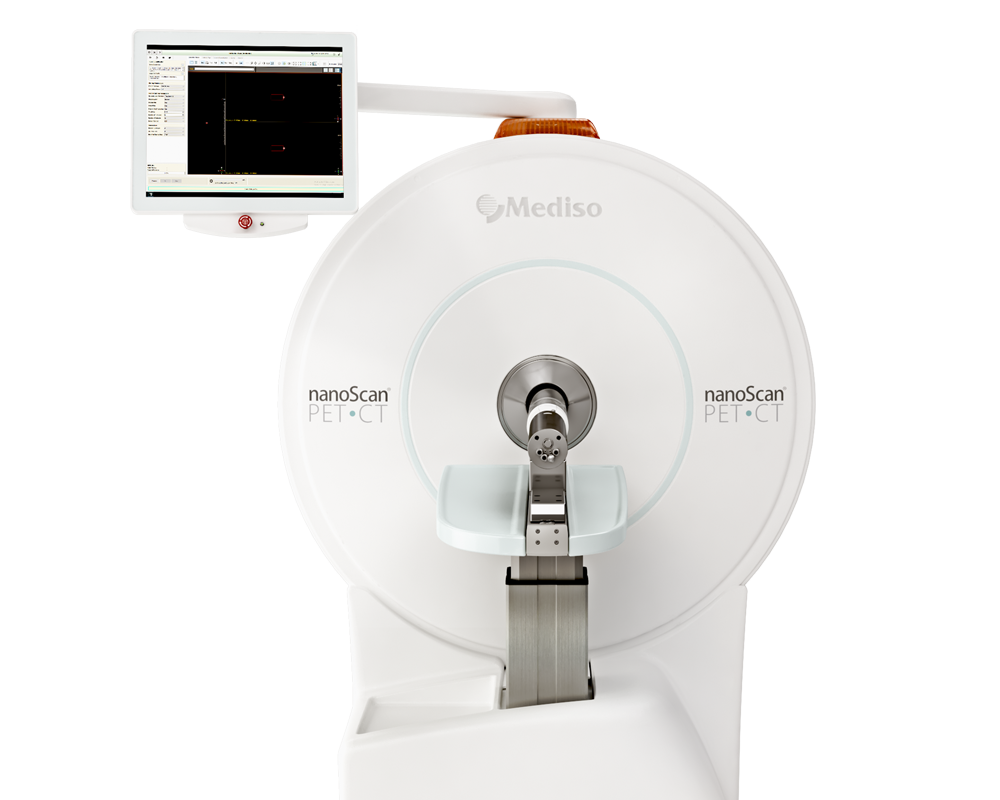
Results from nanoScan® PET/CT
- Compared to naive mice, investigators observed a 4-fold increase ex vivo in 18F-FDG bone marrow uptake following i.p. LPS injection, indicative of systemic hyperinflammation
- LPS-injected mice (hyperinflammation) and Acute respiratory distress syndrome (ARDS) model mice that received the mTORi-nanobiologic treatment displayed significantly less bone marrow activity

Figure 4 mTORi-nanobiologics reduce systemic inflammation (A) Schematic overview of the LPS-induced hyperinflammation mouse model. (B) Representative fused 18F-FDG PET/CT images of the spine of placebo (left panel) and mTORi-nanobiologics-treated (right panel) animals. (C) Ex vivo quantification of bone marrow 18F-FDG uptake (n = 7–11). (D) Representative flow cytometry plots showing Ly6Chi monocytes in the bone marrow of control naive mice (negative control), mice with hyperinflammation (placebo control), and hyperinflammation mice treated with mTORi-nanobiologics, gated on live CD45+CD11b+lin−CD11c− cells (left panel) and the associated quantification of bone marrow Ly-6Chi monocytes (right panel, n = 6). (E) Representative flow cytometry plots showing neutrophils in the bone marrow of control naive mice (negative control), untreated hyperinflammation mice (placebo control), and hyperinflammation mice treated with mTORi-nanobiologics, gated on live CD45+ cells (left panel). The associated quantification of bone marrow neutrophils is also shown (right panel, n = 6).

Figure 5 mTORi-nanobiologics reduce inflammation in ARDS mouse model (A) Schematic overview of the LPS-induced ARDS mouse model. (B) Representative fused 18F-FDG PET/CT images of the lungs of untreated (placebo control, left panel) and mTORi-nanobiologics-treated (right panel) animals. (C) Ex vivo quantification of bone marrow 18F-FDG uptake (n = 6–11). (D) Ex vivo quantification of 18F-FDG lung uptake (n = 4–9).
W czym możemy pomóc?
Skontaktuj się z nami aby uzyskać informacje techniczne i / lub wsparcie dotyczące naszych produktów i usług.
Napisz do nas