124 I-Iodo-DPA-713 Positron Emission Tomography in a Hamster Model of SARS-CoV-2 Infection
2021.08.23.
Camilo A. Ruiz-Bedoya et al.,
Molecular Imaging and Biology 2021
Abstract
Purpose: Molecular imaging has provided unparalleled opportunities to monitor disease processes, although tools for evaluating infection remain limited. Coronavirus disease (COVID-19) caused by severe acute respiratory syndrome coronavirus 2 (SARS-CoV-2) is mediated by lung injury that we sought to model. Activated macrophages/phagocytes have an important role in lung injury, which is responsible for subsequent respiratory failure and death. We performed pulmonary PET/CT with 124I-iodo-DPA-713, a low-molecular-weight pyrazolopyrimidine ligand selectively trapped by activated macrophages cells, to evaluate the local immune response in a hamster model of SARS-CoV-2 infection.
Procedures: Pulmonary 124I-iodo-DPA-713 PET/CT was performed in SARS-CoV-2-infected golden Syrian hamsters. CT images were quantified using a custom-built lung segmentation tool. Studies with DPA-713-IRDye680LT and a fluorescent analog of DPA-713 as well as histopathology and flow cytometry were performed on post-mortem tissues.
Results: Infected hamsters were imaged at the peak of inflammatory lung disease (7 days post-infection). Quantitative CT analysis was successful for all scans and demonstrated worse pulmonary disease in male versus female animals (P < 0.01). Increased 124I-iodo-DPA-713 PET activity co-localized with the pneumonic lesions. Additionally, higher pulmonary 124I-iodo-DPA-713 PET activity was noted in male versus female hamsters (P = 0.02). DPA-713-IRDye680LT also localized to the pneumonic lesions. Flow cytometry demonstrated a higher percentage of myeloid and CD11b + cells (macrophages, phagocytes) in male versus female lung tissues (P = 0.02).
Conclusion: 124I-Iodo-DPA-713 accumulates within pneumonic lesions in a hamster model of SARS-CoV-2 infection. As a novel molecular imaging tool, 124I-Iodo-DPA-713 PET could serve as a noninvasive, clinically translatable approach to monitor SARS-CoV-2-associated pulmonary inflammation and expedite the development of novel therapeutics for COVID-19.
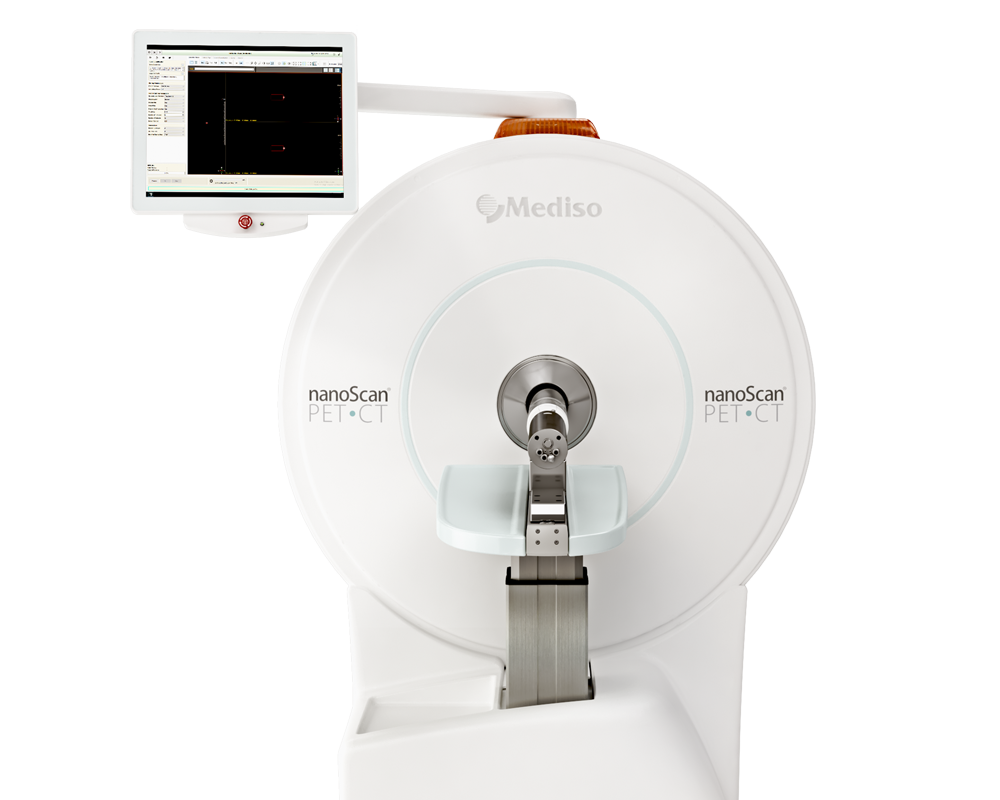
Results from the nanoScan® PET/CT
- 124I-iodo-DPA-713 accumulates within lung lesions in a hamster model of SARS-CoV-2 infection
- Subtle differences between the host response of males and females can be quantified by using an unbiased CT lung segmentation tool as well as by 124I-iodo-DPA-713 PET
- 124I-Iodo-DPA-713 PET could serve as a noninvasive, clinically translatable approach to monitor SARS-CoV-2-associated pulmonary inflammation and expedite the development of novel therapeutics for COVID-19

Fig. 3 Pulmonary 124I-iodo-DPA-713 PET/CT of SARS-CoV-2-infected hamsters. a Transverse lung sections of a representative hamster imaged with 124I-iodo-DPA-713 showing higher uptake within the GGO and pneumonic areas. b124I-iodo-DPA-713 PET activity is higher in pneumonic regions compared to unaffected lung. c DPA-713-IRDye680LT fluorescence co-localizes with the diseased lung. d124I-iodo-DPA-713 PET signal is higher in male versus female hamsters. A VOI was created for each lung lesion (GGO and consolidations) in males (n = 11), females (n = 11) and unnaffected lung (n = 19). Data represented as median ± interquartile range.
W czym możemy pomóc?
Skontaktuj się z nami aby uzyskać informacje techniczne i / lub wsparcie dotyczące naszych produktów i usług.
Napisz do nas