Exploring a Nitric Oxide-Releasing Celecoxib Derivative as a Potential Modulator of Bone Healing: Insights from Ex Vivo and In Vivo Imaging Experiments
2025.03.13.
Christin Neuber et al., International Journal of Molecular Sciences, 2025
Summary
The inducible enzyme cyclooxygenase-2 (COX-2) and the subsequent synthesis of eicosanoids initiated by this enzyme are important molecular players in bone healing. In this pilot study, the suitability of a novel selective COX-2 inhibitor bearing a nitric oxide (NO)-releasing moiety was investigated as a modulator of healing a critical-size bone defect in rats. A 5 mm femoral defect was randomly filled with no material (negative control, NC), a mixture of collagen and autologous bone fragments (positive control, PC), or polycaprolactone-co-lactide (PCL)-scaffolds coated with two types of artificial extracellular matrix (aECM; collagen/chondroitin sulfate (Col/CS) or collagen/polysulfated hyaluronic acid (Col/sHA3)). Bone healing was monitored by a dual-tracer ([18F]FDG/[18F]fluoride) approach using PET/CT imaging in vivo. In addition, ex vivo μCT imaging as well as histological and immunohistochemical studies were performed 16 weeks post-surgery. A significant higher uptake of [18F]FDG, a surrogate marker for inflammatory infiltrate, but not of [18F]fluoride, representing bone mineralization, was observed in the implanted PCL-scaffolds coated with either Col/CS or Col/sHA3. Molecular targeting of COX-2 with NO-coxib had no significant effect on tracer uptake in any of the groups.
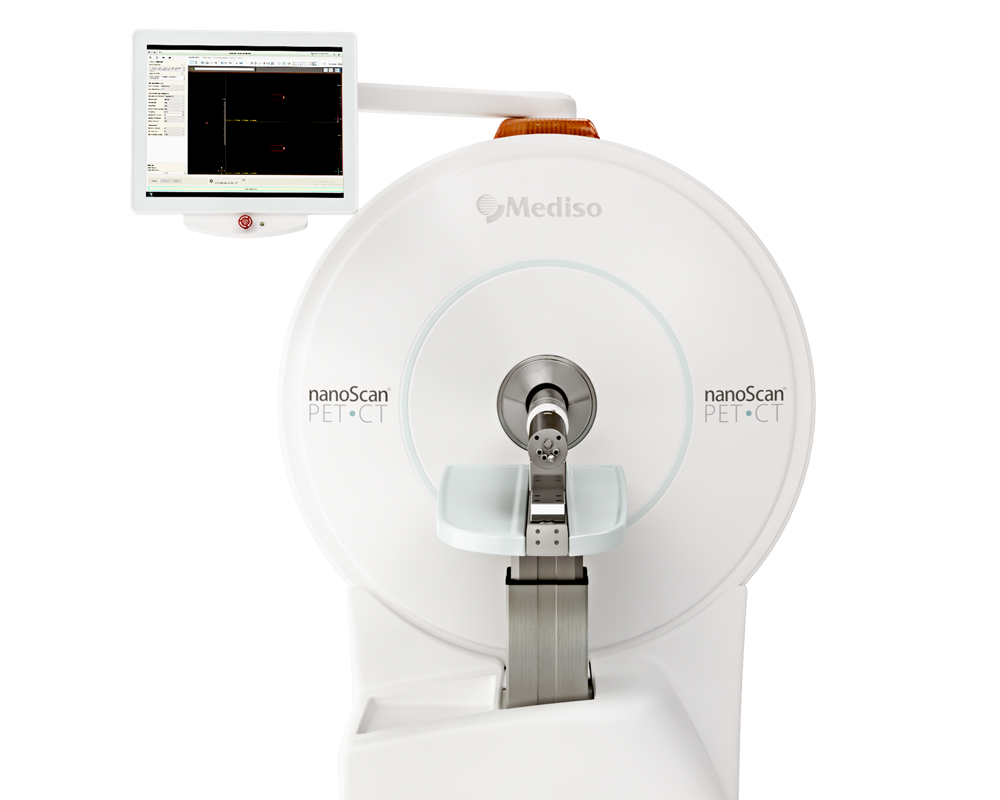
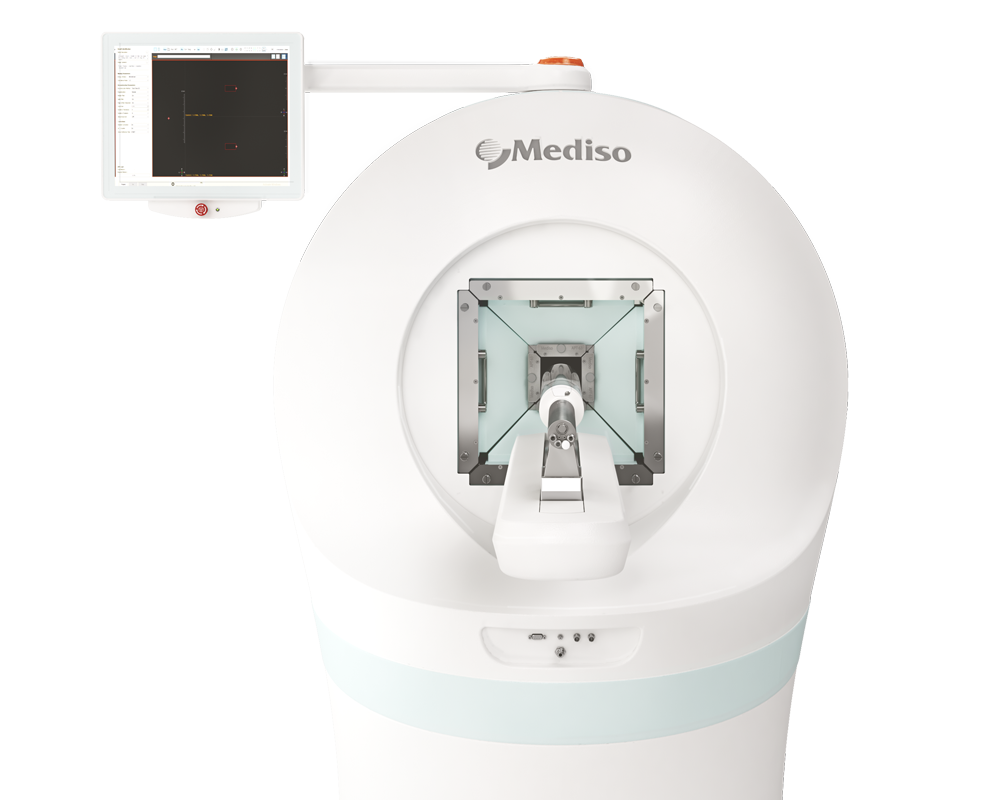
Results from nanoScanPET/CT
Cellular activity in the bone defect area was investigated by PET/CT imaging after i.v. injection of [18F]FDG. Four weeks after establishment of the 5 mm femur defect and implantation of the biomaterials, PET/CT imaging was conducted the first time. At that time, [18F]FDG predominantly accumulated within the bone defect, especially when an aECM-coated PCL-scaffold was implanted (Figure 1a, dashed box). In comparison to the NC and PC, a substantial higher [18F]FDG uptake was observed in the implanted PCL-scaffolds (Col/CS and Col/sHA3) (Figure 1a). For quantification of tracer uptake, standard uptake value (SUV) was determined in a volume of interest (VOI) comprising the bone defect and adjacent bone tissue, which was defined as SUVdefect (Figure 1a, dashed box). SUV values were determined at 4, 8, 12, and 16 weeks post-surgery to generate time activity curves (TAC, Figure 1b) over the whole observation period. To test whether NO delivery to bone defect via COX-2 targeting influences bone defect inflammation and healing, rats were treated at 10 out of 14 days from day 2 to day 14 post-surgery with either NO-coxib or vehicle solution only by s.c. injection next to the surgery site. Compared to the vehicle group (Figure 1b), [18F]FDG uptake in NO-coxib treated rats showed mainly the same SUV levels and time courses (Figure 1c).

Figure 1. [18F]FDG accumulation in the femur defect after insertion of no material (NC), a mixture of collagen and autologous bone fragments (PC), or PCL-scaffolds coated with a mixture of either collagen and chondroitin sulfate (Col/CS) or collagen and polysulfated hyaluronic acid (Col/sHA3). (a) Representative PET/CT images at 4 weeks post-surgery. (b,c) [18F]FDG accumulation in the bone defect (dashed box) was determined (SUVdefect) at 4, 8, 12, and 16 weeks post-surgery without ((b), vehicle solution only) or with adjuvant administration of NO-coxib (c).
[18F]fluoride accumulated, contrary to [18F]FDG, at the bone defect margins in close proximity to the 5 mm femur defect, where highest new bone formation and mineralization is expected (Figure 2a). Only in the PC group, where a mixture of collagen and autologous bone fragments has been implanted, [18F]fluoride accumulation was found in the entire defect (Figure 2a). Only in the PC group, where a mixture of collagen and autologous bone fragments has been implanted, [18F]fluoride accumulation was found in the entire defect. When analyzing TACs (Figure 2b), it became evident that, at 4 and 8 weeks post implantation, [18F]fluoride accumulation was comparable in all four groups and, with the exception of Col/CS, decreased from week 4 to 12.

Figure 2. [18F]Fluoride accumulation in the femur defect after insertion of no material (NC), a mixture of collagen and autologous bone fragments (PC), or PCL-scaffolds coated with a mixture of either collagen and chondroitin sulfate (Col/CS) or collagen and polysulfated hyaluronic acid (Col/sHA3). (a) Representative PET/CT images at 4 weeks post-surgery. (b,c) [18F]Fluoride accumulation in the bone defect (dashed box) was determined (SUVdefect) at 4, 8, 12, and 16 weeks post-surgery without ((b), vehicle solution only) or with adjuvant administration of NO-coxib (c).
Conclusion
- In vivo PET/CT imaging allows for longitudinal investigation of functional markers like glucose consumption and bone mineralization.
- By combining in vivo and ex vivo methods, it was shown that the delivery of NO to the defect area by targeting COX-2, a key molecular player during the inflammatory phase of bone healing, does not significantly influence bone healing in any of the experimental groups, reflecting different clinical situations
- It can support the hypothesis, that NO compensates for the negative effects of the coxib moiety and, thereby, opens the therapeutic window of coxibs for treatment of post-traumatic or post-operative pain and inflammation.
Full article on mdpi.com
Comment pouvons-nous vous aider?
N'hésitez pas à nous contacter pour obtenir des informations techniques ou à propos de nos produits et services.
Contactez-nous