Modular in vivo antibody–ADC click to reverse drug resistance in tumours
2026.07.15.
Cristina Simó et al., Nature, 2026
Summary
Antibody–drug conjugates (ADCs) deliver cancer drugs directly to tumour cells, but their effectiveness can be limited when tumours have low or heterogeneous expression of the targeted antigen. This study introduces a modular in vivo antibody–ADC click strategy designed to overcome this limitation. Therapeutic antibodies and ADCs are modified with complementary trans-cyclooctene and tetrazine groups and administered sequentially, allowing them to bind (“click”) together inside the body. In preclinical tumour models, this approach improved tumour targeting and antitumour activity compared with conventional ADC treatment, including in tumours with low, ultralow, heterogeneous or negative HER2 expression. Because the method can potentially combine different antibodies, ADCs and receptor targets without extensive antibody re-engineering, it could provide a flexible strategy for overcoming tumour heterogeneity and resistance to targeted cancer therapies.
Results from nanoScan® PET/CT
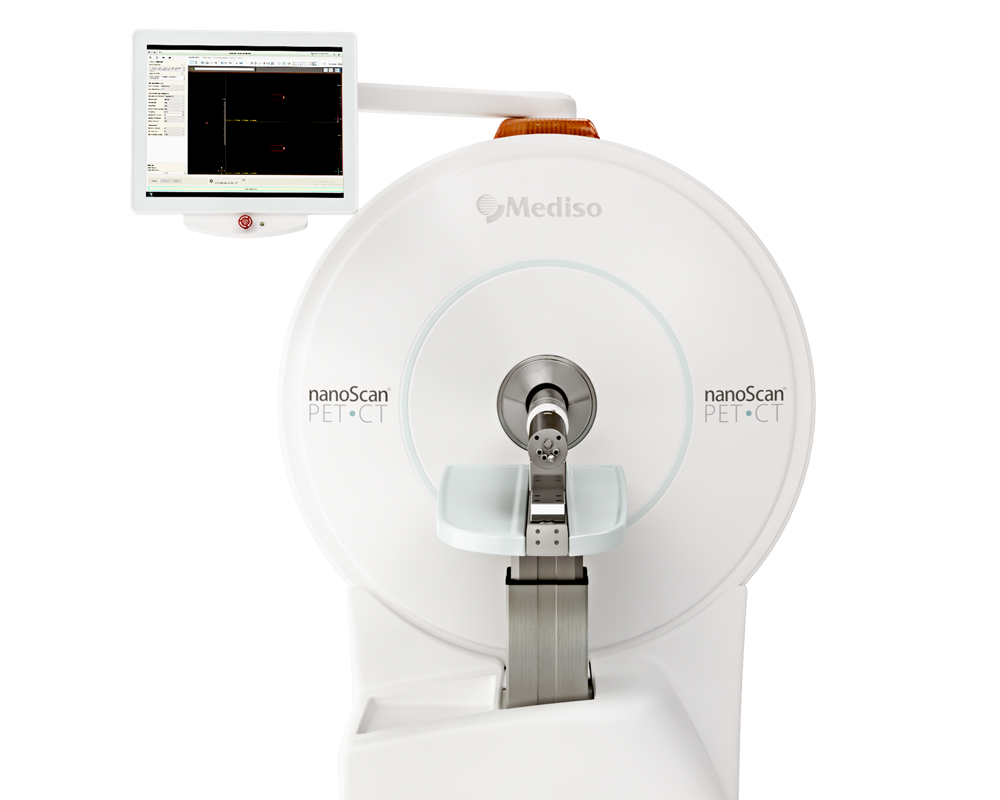
The Mediso nanoScan PET/CT was used for longitudinal immuno-PET imaging to quantify the tumour uptake and biodistribution of radiolabelled antibodies. PET/CT demonstrated enhanced tumour targeting achieved by the in vivo antibody–ADC click strategy, including in tumours with low or heterogeneous target expression.
The Authors:
- Quantified tumour uptake and biodistribution of radiolabelled antibodies.
- Demonstrated enhanced and prolonged tumour accumulation with the in vivo antibody–ADC click strategy.
- Showed improved targeting of tumours with low, ultralow, or heterogeneous target expression.
- Demonstrated reduced off-target accumulation compared with control approaches

Fig. 1.: Antibody–ADC click enhances tumour uptake and therapeutic efficacy.
Fig.1.: (a,b) PET–CT image a) and biodistribution b) of 64Cu-labelled trastuzumab–tetrazine in NCIN87 tumours at 24 h after injection. 64Cu-labelled trastuzumab–tetrazine was administered 24 h after injection of panitumumab–TCO (n = 3 mice, biological replicates). c) Left, IHC images of HER2 and EGFR in a bilateral tumour model (highlighted areas in the image to the left) inoculated with A431 (HER2ULEGFRhigh, HER2 IHC of 1+/0; green) and NCIN87 (HER2+EGFRlow, HER2 IHC of 3+; orange) xenografts. Right, PET–CT analyses show uptake of 64Cu-labelled trastuzumab–tetrazine alone compared with after click with panitumumab–TCO (n = 3 mice per group, biological replicates). 64Cu-trastuzumab–tetrazine was administered 24 h after panitumumab–TCO. PET–CT images were collected 24 h after 64Cu-trastuzumab–tetrazine administration. Scale bars, 250 µm. d) 64Cu-labelled trastuzumab–tetrazine biodistribution at 24 h after injection in the bilateral A431 and NCIN87 tumour model shown in c, comparing 64Cu-trastuzumab–tetrazine single antibody versus panitumumab–TCO plus 64Cu-trastuzumab–tetrazine (click) e) Tumour growth curves in the bilateral A431 and NCIN87 tumour model. T-DXd click (panitumumab–TCO plus T-DXd–tetrazine) improved efficacy compared with no click (panitumumab plus T-DXd) or saline. f) Responses in individual NCIN87 tumours following treatment with T-DXd, no click (panitumumab plus T-DXd) or T-DXd click (panitumumab–TCO plus T-DXd–tetrazine).
¿como podemos ayudarlo?
Póngase en contacto con nosotros para obtener información técnica, productos y servicios!
Ponerse en contacto