Characterization of a 64Cu-Labeled Heterobivalent Bicyclic Peptide (Nectin-4/Albumin) for Targeting of Tumor-Associated Nectin-4
2026.08.26.
Tobias Krönke et al., Molecular Pharmaceutics, 2026
Summary
The cell adhesion protein Nectin-4 has been proven as an effective target for therapeutic approaches in bladder cancer. In addition, the interest as a target protein for targeted radionuclide theranostic approaches is growing. While several promising radioligands for imaging purposes have been described in recent years, therapeutic radioligands are largely missing so far, which is mainly reasoned by a comparatively low uptake into the tumor tissue accompanied by a fast washout kinetic of the radioligand. In this study, the authors investigated how the introduction of an albumin-binding unit into the previously developed ligand NECT-224 can improve the integral tumor uptake. The resulting heterobivalent ligand NECT-308 was successfully synthesized via solid-phase peptide synthesis. PET imaging studies using the new ligand in HT-1376 tumor-bearing mice highlighted an almost fourfold higher integral tumor uptake of [64Cu]Cu-NECT-308 over 24 h compared to applying [64Cu]Cu-NECT-224.
Results from nanoScan® PET/CT
When the tumor volume reached 200 mm3, PET experiments with radiotracers were performed. 9 MBq (≈0.46 nmol) was injected per animal on average. Coincidences were recorded continuously in a 2 h PET scan starting with the injection. Additionally, a CT scan was performed for anatomical referencing and attenuation correction.
- The distribution of [64Cu]Cu-NECT-308 was studied in a HT-1376 tumor xenograft model up to 48 h after intravenous injection. Previously, the distribution of [64Cu]Cu-NECT-224 was characterized in scanning mice up to 2 h p.i. Therefore, the PET/CT imaging experiments were repeated until 24 h p.i. to enable a side-by-side comparison of the two ligands (see Fig. 1 A and B).
- Two control experiments were performed by blocking Nectin-4 binding using NECT-308-bl (50 nmol, 150-fold excess over [64Cu]Cu-NECT-308, with “bl” referring to “block”). Under these conditions, Nectin-4 binding at the tumor site should be largely blocked. Imaging was done by using [⁶⁴Cu]Cu-NODAGA-cLAB4-scrTATE as well, which contains the albumin-binding unit but lacks the Nectin-4-targeting component. Both controls showed substantial tumor uptake, indicating that the increase observed with NECT-308 was largely attributable to Nectin-4-independent mechanisms (Fig. 1 C and D).
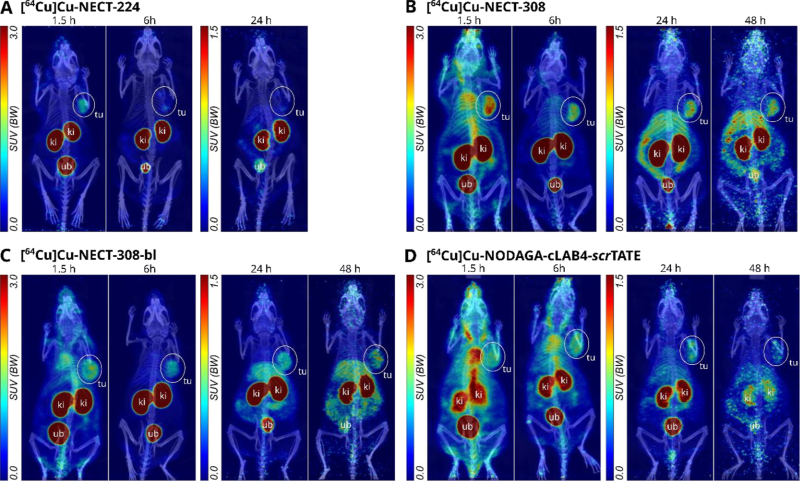
Fig. 1. PET images for the different 64Cu-labeled peptides. (A−D) Exemplary PET/CT images at the time points of 1.5 h, 6 h, 24 h, and 48 h after intravenous injection of [64Cu]Cu-NECT-224 (A), [64Cu]Cu-NECT-308 (B), [64Cu]Cu-NECT-308-bl (C), and [64Cu]Cu-NODAGA-cLAB4-scrTATE (D). Images are presented as maximum intensity projections with a common scale (SUV 0−3 for 1.5 h and 6 h and SUV 0−1.5 for 24 h and 48 h). Anatomical positions of the tumor (tu), kidney (ki), and urinary bladder (ub) are indicated.
- The time-activity curves (TACs) for tumor, heart, and kidneys are shown in Fig. 2. The highest tumor-to-heart (T/H) ratio with [64Cu]Cu-NECT-308 was observed at 6 h p.i. and was largely constant up to 48 h p.i. Similarly, the tumor-to-muscle (T/M) ratio was higher at later time points, with the highest ratio being reached at 48 h p.i. On total an almost fourfold increase in integral tumor uptake was showed when using [⁶⁴Cu]Cu-NECT-308, measured as the area under the time–activity curve (AUC), compared with [⁶⁴Cu]Cu-NECT-224.
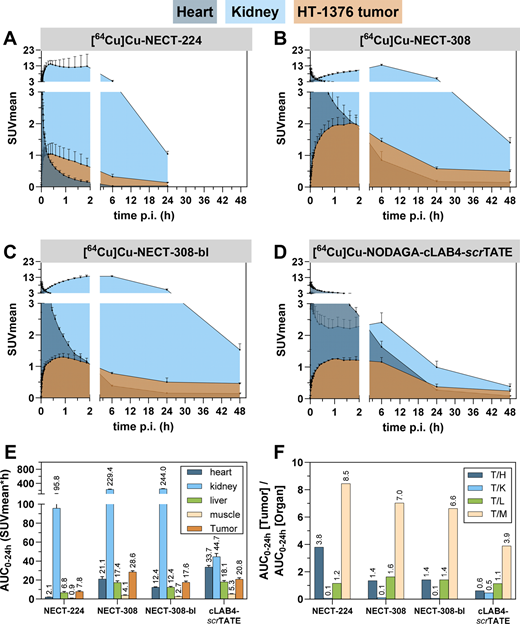
Fig. 2. PET imaging data for the 64Cu-labeled peptides. (A−D) Time-activity curves (SUVmean, decay-corrected, as a function of time up to 48 h) obtained by PET acquisition are depicted (0−2 h in dynamic mode and time points of 5, 24, and 48 h p.i.; the x-axes are segmented accordingly). The area under the respective curves are filled with color for better visualization. (E) Calculated AUC0−24h values. (F) Tumor/organ ratios are based on the AUC0−24h values.
- Based on the mouse PET/CT biodistribution data, the estimated tumor absorbed dose for therapeutic [⁶⁷Cu]Cu-NECT-308 was 121 mGy/MBq, compared with 25.9 mGy/MBq for [⁶⁷Cu]Cu-NECT-224. The albumin-binding modification also increased renal accumulation; the 0–24 h kidney AUC for NECT-308 was approximately 2.5 times higher than that for NECT-224. This is a major limitation for potential therapeutic applications because the kidneys were identified as the dose-limiting organs in the dosimetry analysis.
Overall, the PET/CT results demonstrated that incorporating an albumin-binding unit into NECT-224 substantially increases the tumor-associated radiotracer uptake and prolongs the circulation in the blood. However, the blocking and control experiments indicated that the increased tumor accumulation is largely Nectin-4-independent, raising questions about whether this approach would reliably improve target-specific tumor irradiation in clinical applications. Besides, the concomitant increase in kidney uptake further limits the new ligand’s therapeutic potential. The authors conclude that further structural optimization is required to achieve higher and more sustained Nectin-4-dependent tumor uptake while reducing renal accumulation.
Full article on pubs.acs.org
¿como podemos ayudarlo?
Póngase en contacto con nosotros para obtener información técnica, productos y servicios!
Ponerse en contacto