The Binding of the High Affinity Radioligand Fallypride to the D2-dopamine Receptor is Sensitive to Injected Mass – a PET Study in Rodents
2026.03.16.
Tóth M. et al., Molecular Imaging and Biology, 2026
Summary
Fallypride is radioligand widely used to D2-dopamine receptor experiments in both rodent and human brains. While planning studies with this tracer the “mass effect” must be considered; this refers to the partial saturation of receptors in the target tissue due to the injected mass of the ligand. To examine this issue, fallypride was administered at three different activity levels to a cohort of 8 mice; [11C]fallypride (highest molar activity), and [18F]fallypride at both high and low molar activity levels. PET imaging was performed using the Mediso nanoScan® P122S PET/CT and PET/MRI systems. The results demonstrated a strong negative correlation between the binding potential (BPND) and the injected mass. This study illustrated the high sensitivity of D2-dopamine receptor to the injected tracer mass and highlights the need for well-controlled and consistent molar activity levels in small animal studies.
Results from nanoScan® PET/MRI and nanoScan® PET/CT
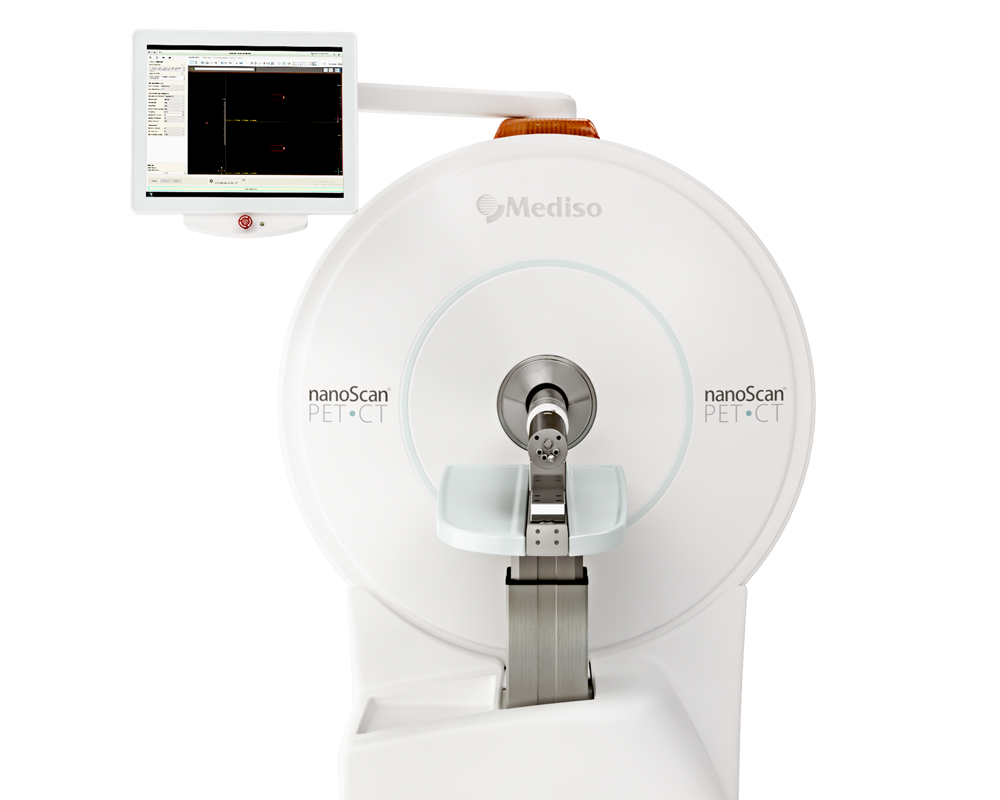
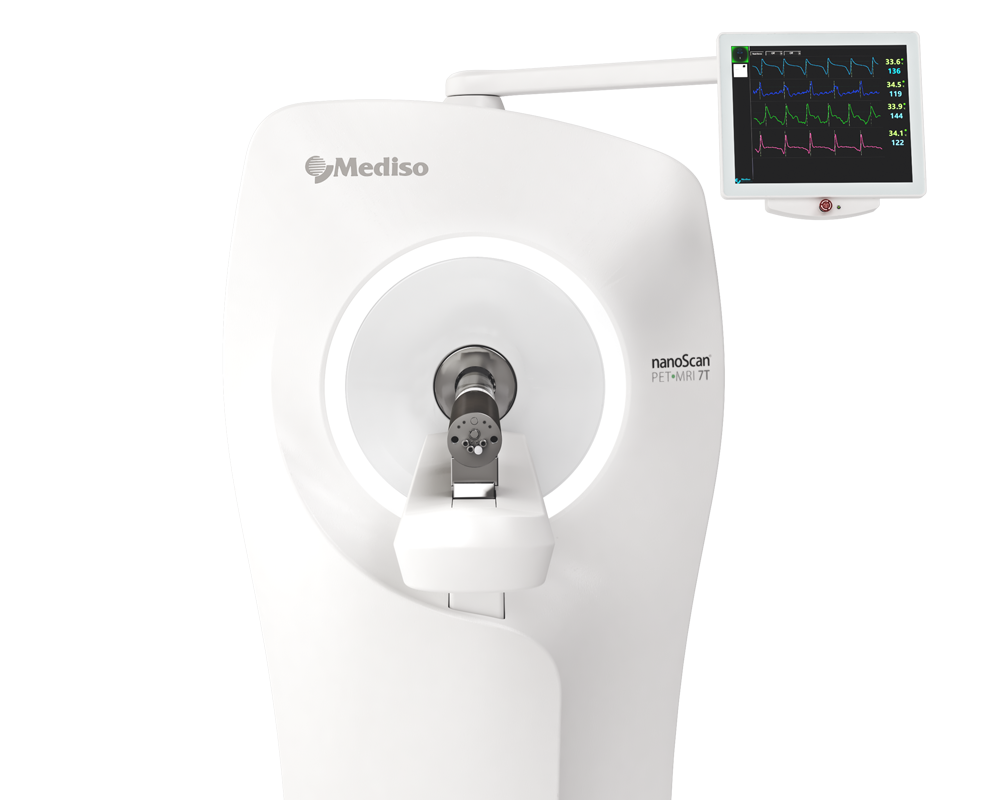
Eight 3-month-old C57BL/6J mice were included in the study. Animals were group-housed in a thermoregulated (~ 22 °C) and humidity-controlled environment under a 12 h/12 h light/dark cycle, with food and water available ad libitum. The injected molar activity of the [11C]fallypride was 153.3±81.7 GBq/µmol, while the [18F]fallypride tracers were administered at 44.9±11.1 GBq/µmol (high MA) and 21.2±4.8 GBq/µmol (low MA). For all measurements, the total injected activity was approximately 12 MBq. Under anesthesia, animals were placed on a heated bed with vital signs monitored continuously by the system. Following intravenous injection, dynamic PET imaging was performed with the brain positioned in the center of the field of view. Imaging was conducted using two cross-calibrated nanoScan® P122S PET scanners: a PET/CT and a PET/MRI system.
The 93-minute scans were framed into 25 time intervals (4×10 s, 4×20 s, 4×60 s, 7×180 s, 11×360 s) and reconstructed using Tera-Tomo® 3D iterative algorithm (20 iterations). PET images were coregistered to a mouse MRI template, and Standardized Uptake Values (SUV) were calculated (Fig. 1).
Fig. 1. Average images of fallypride uptake at three conditions shown in horizontal sections (top) and PET overlaid on the MRI template (bottom). The number of animals included in each condition [11C]fallypride n = 6, [18F]fallypride n = 8 and [18F]fallypride lowerMA n = 8.
The non-displaceable binding potential (BPND) was calculated using the cerebellum as the reference region. Statistical significance was determined via one-way ANOVA with Bonferroni’s multiple comparison post-test and Scatchard analysis (Fig. 2).Fig. 2 a. Binding potential values plotted vs injected mass for the total of 22 PET-measurements b. Scatchard analysis of the same data set. The dots for [11C]fallypride are in yellow, for [18F]fallypride in green and for [18F]fallypride lowerMA in blue.


The BPND values were 13.5 ± 1.1 for [11C]fallypride (n = 6), 8.6 ± 2.2 BPND for [18F]fallypride (n = 8) and 5.3 ± 1.3 BPND for [18F]fallypride lowerMA (n = 8). These results demonstrate a strong negative correlation between the injected mass of the fallypride, and its binding potential with an affinity of 0.25 nM.
Wie können wir Ihnen behilflich sein?
Bitte kontaktieren Sie uns für technische Informationen und Unterstützung jeglicher Art in Zusammenhang mit unseren Entwicklungen und Produkten.
Kontaktformular