Efficient 68Ga Labeling of a B7-H3-Targeting Affibody Molecule via Acyclic Tris(hydroxypyridinone) Chelator: Effects on Biodistribution in a Preclinical Model
2026.02.09.
Vladimir Tolmachev et al., International Journal of Molecular Sciences, 2026
Summary
B7-H3 (CD276), an immune checkpoint protein is overexpressed in malignant tumors, while its expression in normal tissues is low, and several B7-H3-targeting therapies are under clinical evaluation. Radionuclide molecular imaging offers a non-invasive method for determining B7-H3 expression levels and may aid in improved patient selection. The selection of an approach for routine labeling providing high radiochemical yields and reproducibility is, however, critical for successful clinical translation. The optimal combination of a targeting protein, chelator/linker, and radionuclide should provide high-contrast visualization. In this article an acyclic chelator, tris(3,4-hydroxypyridinone) (THP) was evaluated for labeling of the Affibody molecule ZB7-H3_2 with 68Ga and its impact was compared on radiolabeling efficiency and targeting properties with the impact of the cyclic chelator 1,4,7-triazacyclononane-1,4,7-triacetic acid (NOTA) (see the graphical abstract on Fig.1).
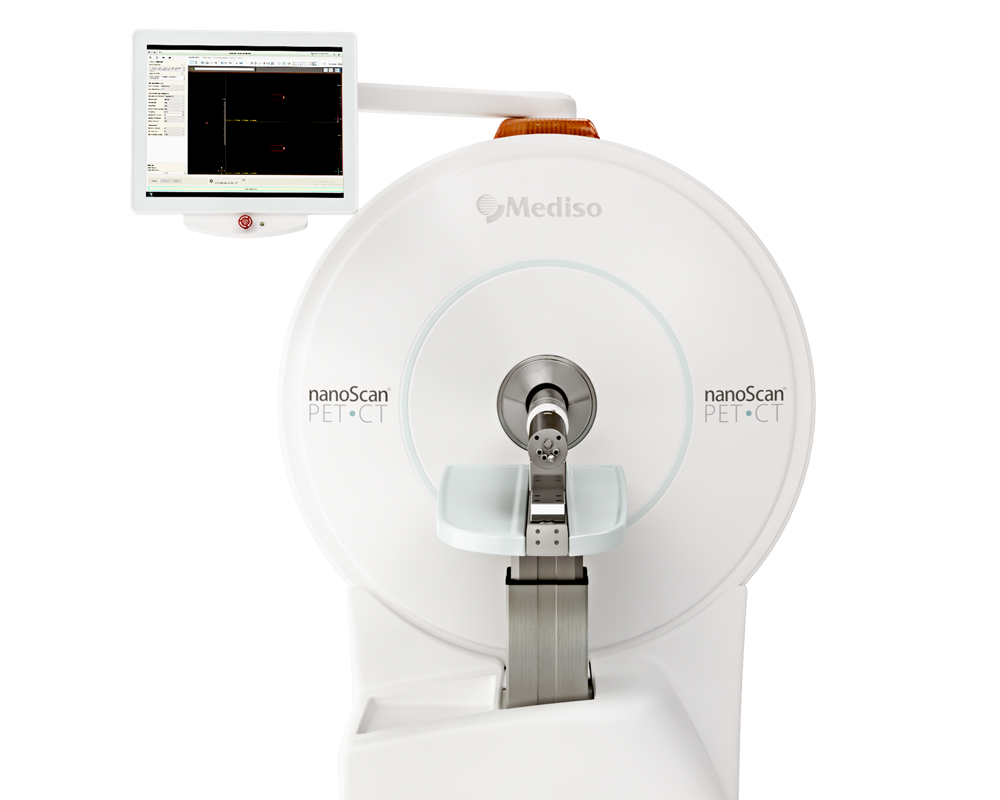
Biodistribution and in vivo specificity results were confirmed by imaging with nanoScan® PET/CT system.
Biodistribution of 68Ga-labeled Affibody conjugates was measured in BALB/C nu/nu mice bearing B7-H3-positive SKOV-3 xenografts (injected on the right hind leg) and for in vivo specificity, B7-H3-negative Ramos xerographs were used (implanted on the left hind leg) and measured three weeks after cell implantation. The PET scans were performed for 30 min 2 h after injection with the same peptide mass and activity (0.28 nmol 400 kBq). CT examination was done using the following parameters: CT-energy peak of 50 keV, 670 A, 480 projections, and a 2.29 min acquisition time. The PET data were reconstructed into a static image using the Tera-Tomo™ 3D reconstruction engine.
To confirm biodistribution results, one SKOV-3-bearing mouse was intravenously injected with 68Ga-labeled Affibody molecules (0.28 nmol and 2.5 MBq). To confirm in vivo specificity, one mouse bearing a Ramos xenograft was intravenously injected with the same peptide and activity dose.
- Imaging with the nanoScan® PET/CT system demonstrated that the biodistribution of [68Ga]Ga-THP- and -NOTA-ZB7-H3_2 was comparable across most organs. The tumor uptake was similar for both radioconjugates, resulting in a similarly high signal from the tumor.
- The applied imaging technique enabled to highlight the significant difference in tumor uptake in SKOV-3 and Ramos xenografts, demonstrating specific binding of [68Ga]Ga-THP-ZB7-H3_2 in vivo (see Fig. 2.).
Fig. 2. Biodistribution of [68Ga]Ga-THP-ZB7-H3_2 in SKOV-3 (B7-H3-positive) and Ramos (B7-H3-negative) xenografts.

- Several non-target organs showed a tendency toward higher uptake for [68Ga]Ga-THP-ZB7-H3_2. [68Ga]Ga-NOTA-ZB7-H3_2 provided slightly but significantly higher tumor-to-liver and tumor-to-spleen ratios, resulting in better imaging contrast in the spleen and liver - an important consideration for the detection of metastases (see Fig. 3.).
Fig. 3. PET/CT imaging of (A) [68Ga]Ga-THP-ZB7-H3_2 and (B) [68Ga]Ga-NOTA-ZB7-H3_2 in SKOV-3 xenografts 2 h after injection.

Full article on mdpi.com.
How can we help you?
Don't hesitate to contact us for technical information or to find out more about our products and services.
Get in touch