Discovery of a Thermostable Nigerose Phosphorylase for the Efficient Chemoenzymatic Radiosynthesis of a S. aureus–Targeted 18F-Disaccharide
2026.06.25.
Jung Min Kim et al., Journal of Nuclear Medicine, 2026
Summary
Staphylococcus aureus is a highly dangerous pathogen, since these infections are a leading cause of death within infectious diseases. Early detection is key to effectively treating the illness. Currently, [18F]FDG is deployed for this purpose, even though this tracer is unable to differentiate between infection and inflammation. In this study, the nigerose phosphorylase derived tracer [18F]FSK was found to be an excellent candidate for specific bacterial imaging and was characterized through rigorous in vivo imaging studies. The tracer showed robust uptake by S. aureus isolates and low non-specific signals, while enabling quantitative conversion of [18F]FDG to [18F]FSK, which could facilitate its clinical implementation.
Results from nanoScan® P123S PET/CT
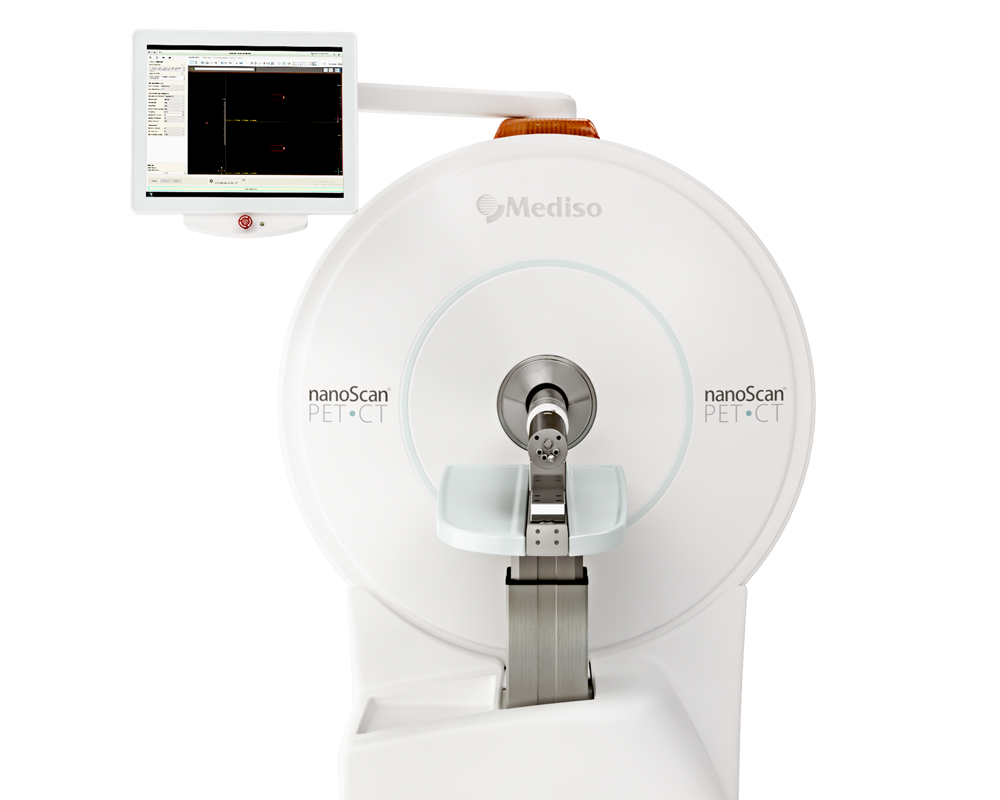
Preclinical PET/CT imaging was a cornerstone of this study. PET scans were acquired and subsequently reconstructed using a 0.8 mm voxel size and the TeraTomo™ 3D algorithm. The primary purpose of CT imaging was to provide attenuation and scatter correction. To characterize the [18F]FSK tracer, four uninfected mice underwent dynamic PET/CT imaging. Subsequently, longitudinal PET imaging was performed on ten infected mice. These mice were treated with oxacillin starting at day 0, which was switched to vancomycin at day 3.

Figure 1 A Dynamic small-animal PET/CT biodistribution analysis of [18F]FSK in uninfected mice. B Representative longitudinal [18F]FSK small-animal PET/CT images of MRSA-inoculated mice acquired at days 0, 3, 6, and 9. Region of interest analysis of [18F]FSK at infected tissue over time.
The preclinical imaging results not only revealed that the [18F]FSK tracer is effective in detecting S. aureus, but also demonstrated its excellent quantitative conversion from the widely used [18F]FDG.
Full article on jnm.snmjournals.org
How can we help you?
Don't hesitate to contact us for technical information or to find out more about our products and services.
Get in touch