Stress-induced takotsubo syndrome: dynamic changes in regional cerebral metabolism revealed by quantitative PET imaging
2026.03.13.
Alejandro Ariza-Carrasco et al., NeuroImage, 2026
Summary
The effects of acute catecholaminergic stress on regional cerebral glucose metabolism were investigated in a Takotsubo syndrome (TTS) rat model using FDG-PET/CT imaging. In the acute phase following isoprenaline administration, widespread reductions in glucose inflow and phosphorylation were observed, particularly in limbic and sensorimotor regions, and many of these alterations persisted into the recovery phase. These findings suggest that stress-induced and sustained alterations in brain metabolism may contribute to the long-term consequences of TTS.
Results from nanoScan® PET/CT
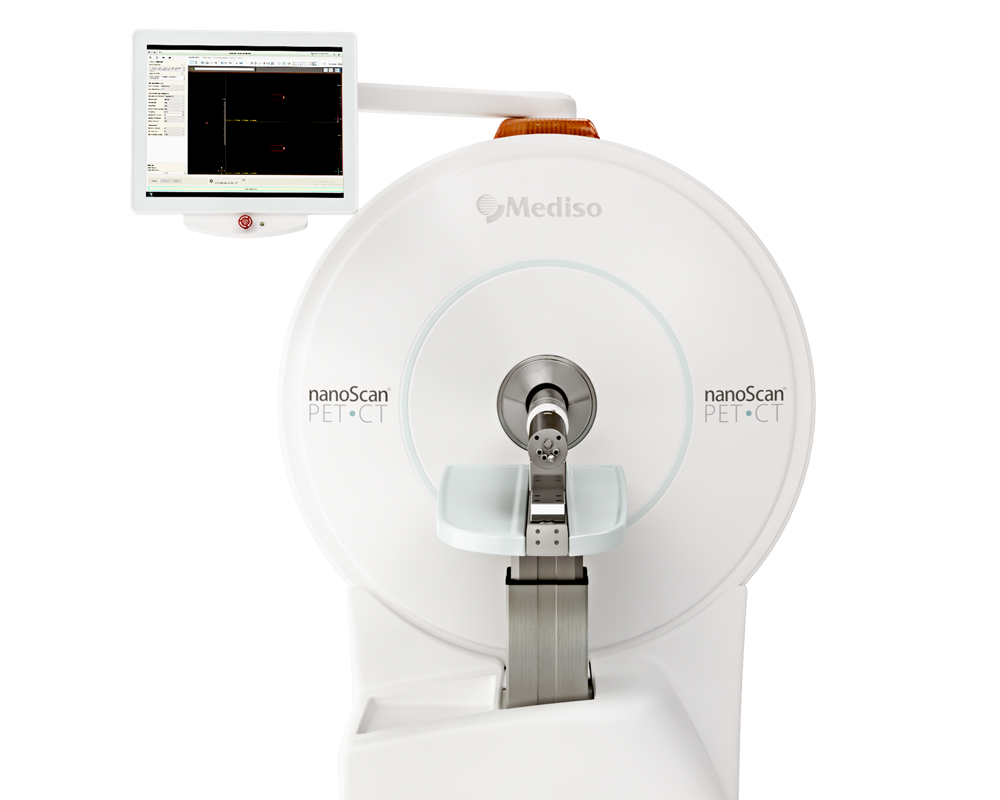
An acute stress–induced Takotsubo syndrome (TTS) model was established in 12-week-old female Wistar rats by a single intraperitoneal injection of isoproterenol (50 mg/kg), with animals evaluated at baseline, 2 hours, and 7 days post-injection under standardized and ethically approved conditions Following intravenous administration of 32.2 ± 1.8 MBq FDG (0.4 mL saline), dynamic whole-body PET/CT imaging was performed using a nanoScan® PET/CT scanner (Mediso Medical Imaging Systems, Hungary), with PET data collected in list mode and reconstructed with a 3D-OSEM–based Tera-Tomo algorithm into 23 frames of varying durations (30 s; 6×5 s; 4×10 s; 6×30 s; 3×120 s; 4×300 s). Time-activity curves were extracted from 58 brain regions using two-tissue compartment modeling to obtain kinetic parameters K1 (glucose inflow) and k3 (FDG phosphorylation) across all time points, and interregional correlations between these parameters were analyzed to assess coordinated metabolic behavior across functional brain areas. (Fig. 1).

Figure 1. Dynamic FDG-PET/CT imaging was performed over 30 minutes in 23 consecutive time frames, with brain images processed and analyzed to extract kinetic parameters (K1 and k3) from 58 regions and assess interregional metabolic coordination.
In the acute phase, the limbic and sensorimotor areas showed increased coordination of glucose inflow (K1) but a marked decline in phosphorylation (k3) synchronization, reflecting enhanced inflow coupling alongside disrupted metabolic processing. During the recovery phase, K1 coordination remained elevated in both regions, while k3 coordination continued to decrease, indicating persistent disruption of glucose phosphorylation despite sustained inflow synchronization.
Conclusion
FDG-PET/CT imaging revealed that acute catecholaminergic stress in the TTS rat model induces persistent cerebral hypometabolism and disrupted interregional coordination of glucose utilization, which continue beyond the recovery of peripheral cardiac function. These findings highlight the value of PET/CT–based cerebral metabolic assessment for capturing long-lasting brain alterations associated with TTS and underscore the importance of considering brain-heart interactions in the disease’s pathophysiology.
Full article on sciencedirect.com
Wie können wir Ihnen behilflich sein?
Bitte kontaktieren Sie uns für technische Informationen und Unterstützung jeglicher Art in Zusammenhang mit unseren Entwicklungen und Produkten.
Kontaktformular