A novel diagnosis strategy for chronic inflammatory bowel diseases using immuno-PET of [89Zr]Zr-IL-23p19 antibody
2025.11.29.
Nare Ko et al., Scientific Reports, 2025
Abstract
Inflammatory bowel disease (IBD) is a chronic inflammatory condition requiring accurate and non-invasive imaging for diagnosis and monitoring. Current clinical methods, including Disease Activity Index (DAI) scoring, have limitations due to their subjectivity and inability to detect mild or early inflammation. This study introduces a novel 89Zr-labeled IL-23p19 monoclonal antibody ([89Zr]Zr-IL-23p19) for targeted immuno-PET imaging in a dextran sulfate sodium-induced murine IBD model. Radiolabeling of IL-23p19 antibody with [89Zr]Zr yielded a stable tracer with high radiochemical purity. PET/MR imaging showed focal accumulation of [89Zr]Zr-IL-23p19 in inflamed colonic regions, aligning closely with histological inflammation and IL-23p19 expression. In contrast, the previous metabolic tracer [18F]FSPG demonstrated diffuse uptake without clear localization to inflamed tissues. Quantitative PET analysis indicated a significant correlation between [89Zr]Zr-IL-23p19 uptake and DAI scores, whereas [18F]FSPG exhibited weak correlations. These results highlight [89Zr]Zr-IL-23p19 immuno-PET imaging as a sensitive, specific, and non-invasive biomarker with strong potential for clinical translation in diagnosing and monitoring chronic intestinal inflammation in patients with IBD.
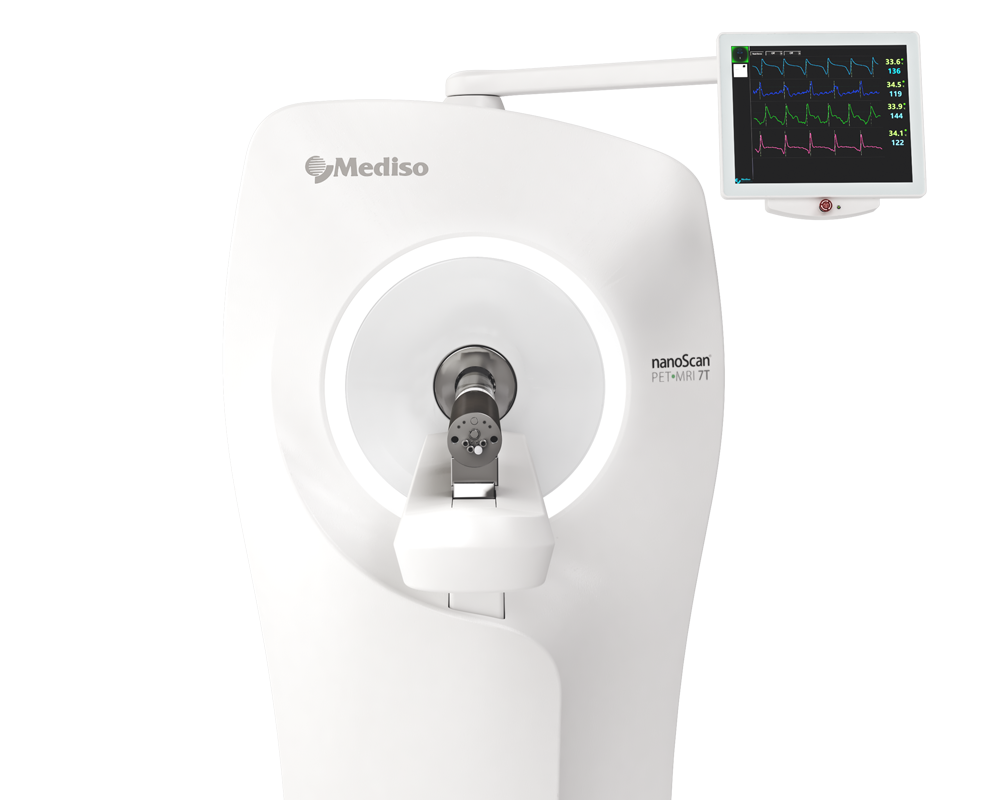
Results from nanoScan® PET/MRI 1T
Mice were divided into three groups: control, [89Zr]Zr-IL-23p19 imaging group, and [18F]FSPG imaging group. PET/MR imaging with [89Zr]Zr-IL-23p19 was performed on days 10 and 14 following DSS (dextran sulfate sodium) administration. Imaging with [18F]FSPG was also conducted on days 10 and 14. Radiotracers were administered via tail vein injection.


Fig. 5. PET/MR imaging and quantitative analysis of DSS-induced mouse models. (a) Representative axial and coronal PET/MR fusion images and corresponding T1-weighted MR images of control (left), [89Zr]Zr-IL-23p19–injected (center), and [18F]FSPG–injected (right) mice. SUVmean of [89Zr]Zr-IL-23p19 (b) and [18F]FSPG (c). Lesion-to-muscle uptake ratio of [89Zr]Zr-IL-23p19 (d) and [18F]FSPG (e).
As shown in Fig. 5a, control mice exhibited only background-level uptake of both tracers, with no focal accumulation in the abdominal region, consistent with the absence of intestinal inflammation. In contrast, DSS-treated IBD mice injected with [89Zr]Zr-IL-23p19 demonstrated intense and well-localized PET signals within the intestine, which co-registered precisely with the bowel wall on MR images. The uptake pattern displayed a characteristic focal distribution along inflamed colonic segments, consistent with histologically confirmed inflammation observed in vitro. The PET/MR fusion images further enabled precise anatomical localization of tracer accumulation.
Full article on nature.com
How can we help you?
Don't hesitate to contact us for technical information or to find out more about our products and services.
Get in touch