Efficacy of quabodepistat alone and in combination with delamanid and bedaquiline against Mycobacterium tuberculosis in an NHP model evaluated by [18F] FDG PET/CT and bacterial burden
2026.11.05.
Laura E Via et al., Antimicrobial Agents and Chemotherapy, 2026
Summary
Multidrug-resistant tuberculosis (MDR-TB) remains a major challenge, highlighting the need for new drugs and more effective treatment combinations. This study evaluated quabodepistat, a novel DprE1 inhibitor, alone and in combination with bedaquiline and delamanid in a common marmoset model of tuberculosis.
Longitudinal ¹⁸F-FDG PET/CT imaging was used to monitor disease progression and treatment response. Quabodepistat-containing regimens demonstrated significant reductions in lung lesion volume after just two weeks. After two months, all treatment groups showed more than 70% reduction in lung disease volume. The triple-drug combination was particularly effective in reducing bacterial burden in pulmonary cavities and necrotic lesions, with efficacy comparable to standard tuberculosis treatment in a preliminary comparison. These findings support further investigation of quabodepistat as a component of shorter tuberculosis treatment regimens.
Results from MultiScan™ LFER150 PET/CT
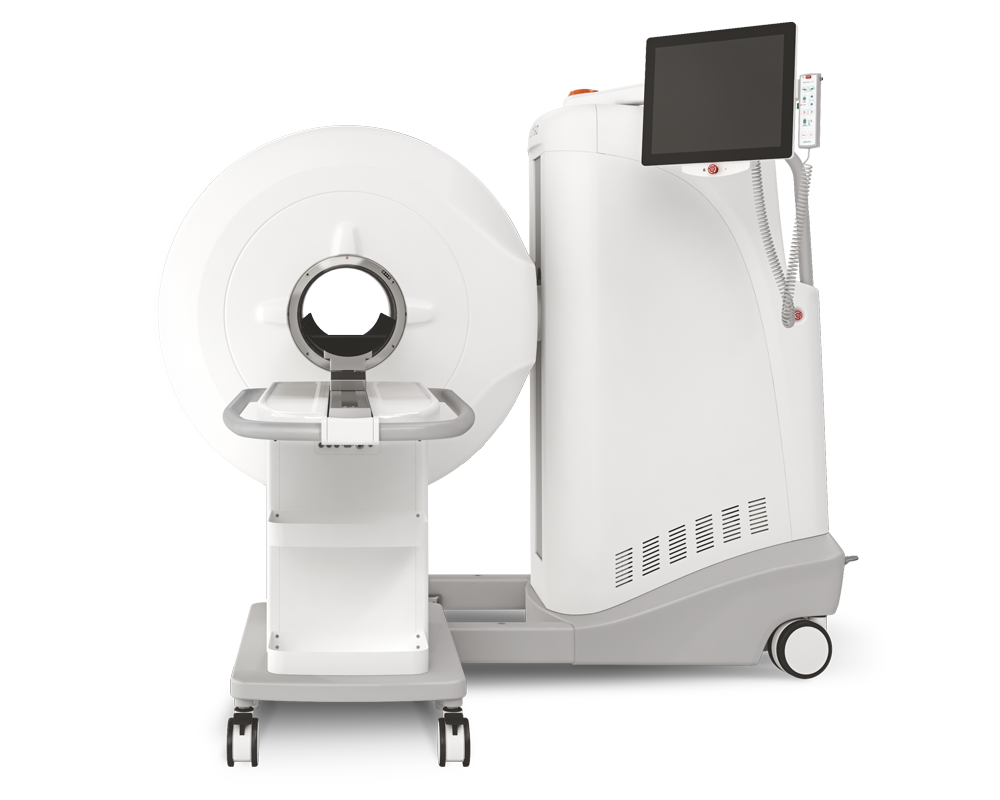
The Mediso LFER-150 PET/CT was used for longitudinal ¹⁸F-FDG PET/CT imaging to monitor pulmonary tuberculosis lesions and evaluate treatment response in infected marmosets.
The authors:
-
Quantified changes in lung disease volume and metabolic activity during treatment.
-
Demonstrated significant reductions in lung lesion volume after two weeks in quabodepistat-containing treatment groups.
-
Showed more than 70% reduction in lung disease volume after two months across all treatment groups.
- Used longitudinal PET/CT imaging to assess treatment efficacy noninvasively and complement terminal bacterial burden and histopathological analyses
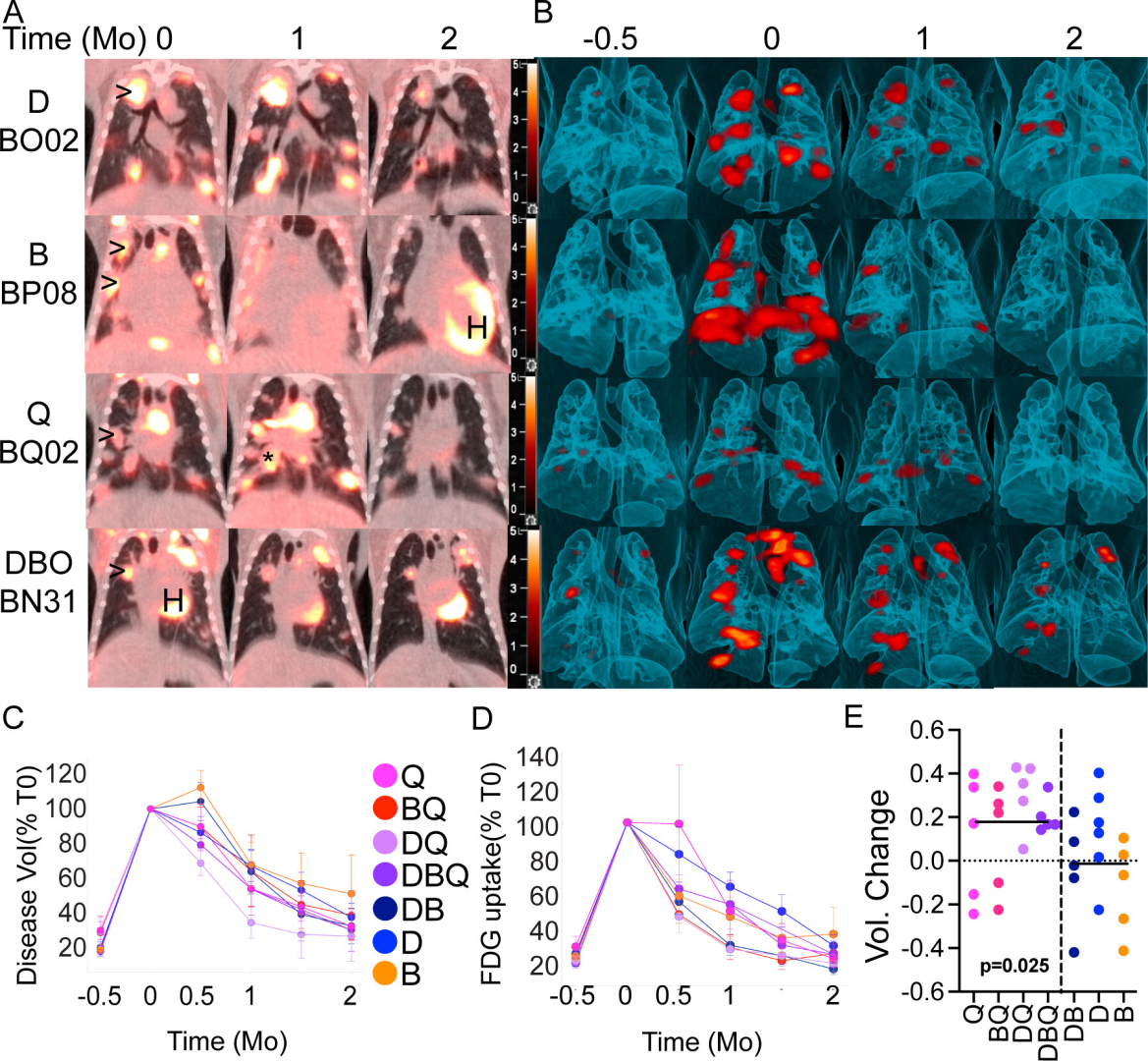
Fig 1. Response to anti-TB therapy as revealed by coronal PET/CT images and 3D maximum image projections in representative marmosets. Treatments and animal ID are indicated on the left of each row of images. (A) Coronal FDG PET/CT images show several individual lesions (arrowheads) and a cavity (*) that shrink and become less FDG-avid in the serial images quantified in panels C and D. The SUV activity scale applies to panel A. An H marks FDG uptake by the heart that is unrelated to M. tuberculosis infection and is excluded from the maximum intensity projections (MIPs). (B) MIPs of the relative FDG uptake in the marmoset lungs from 2 weeks before treatment start (−0.5), pre-treatment (0 month [mo]), and during treatment (1 mo and 2 mo). The 3D MIPs of the lungs show the CT structures (black to light blue), with higher-density tissue as lighter blue. Many lesions appear as light spheres or cup-shaped structures in the less dense, darker lung tissue. The metabolic activity of the lesions is indicated in relative scale from no color (low), red (medium), to yellow (high) FDG uptake in lesions. FDG uptake increased from −0.5 to 0 (treatment start), then decreased during the 1 month after treatment start, and little activity remained after 2 months of treatment as quantified in panel D. (C) Treatment initiated immediately after time point 2 (TP2), and most treatments reduced both mean hard disease volume and (D) mean FDG uptake of the pulmonary lesions (both normalized to TP2), although there was not a significant difference among the treatments at that time point (C and D). Error bars in panels C and D represent the standard deviation of the means. (E) In a post hoc exploratory analysis, the proportional change in total lesion hard volume after 2 weeks of treatment was significantly higher in regimens that included quabodepistat versus those treatment groups without Q to the right. The color assigned for each treatment remains the same throughout (C–E).
Full article on journals.asm.org
Comment pouvons-nous vous aider?
N'hésitez pas à nous contacter pour obtenir des informations techniques ou à propos de nos produits et services.
Contactez-nous